Showing posts with label beryl. Show all posts

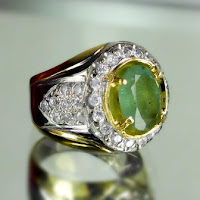
Natural Emerald Beryl [LP241]

Rp 1.100.000,-

Description:
  • Kode : [LP241]
  • Gemstone : Natural Emerald Beryl
  • Dimention : est 9.4x7x4.2mm
  • Weight : est 1.85ct
  • Ring : silver
  • Ring size : 17
Jika tertarik dengan item ini namun sudah terjual, jangan kecewa, silakan klik ini untuk informasi.
Silver dan Alpaka dapat di-resize disesuaikan ukuran jari anda.
..click here for Transaction..

Natural Emerald Beryl [LP233]

Rp 600.000,-

Description:
  • Kode : [LP233]
  • Gemstone : Natural Emerald Beryl
  • Dimention : est 7x6x4.5mm
  • Weight : est 1.25ct
Jika tertarik dengan item ini namun sudah terjual, jangan kecewa, silakan klik ini untuk informasi.
Silver dan Alpaka dapat di-resize disesuaikan ukuran jari anda.
..click here for Transaction..


Natural Emerald Beryl [LP221]

Rp SOLD,-

Description:
  • Kode : [LP221]
  • Gemstone : Natural Emerald Beryl
  • Origin : Columbia
  • Dimention : est 8x6x3.5mm
  • Weight : est 1ct
Jika tertarik dengan item ini namun sudah terjual, jangan kecewa, silakan klik ini untuk informasi.
Silver dan Alpaka dapat di-resize disesuaikan ukuran jari anda.
..click here for Transaction..

Natural Emerald Beryl [LP209]

Rp SOLD,-

Description:
  • Kode : [LP209]
  • Gemstone : Natural Emerald Beryl
  • Origin : Colombia
  • Dimention : est 8.5x5.5x3.5mm
  • Weight : est 1.5ct
  • Ring : silver
  • Ring size : 18
Jika tertarik dengan item ini namun sudah terjual, jangan kecewa, silakan klik ini untuk informasi.
Silver dan Alpaka dapat di-resize disesuaikan ukuran jari anda.
..click here for Transaction..

Natural Aquamarine Beryl [LP177]

Rp SOLD,-

Description:
  • Kode : [LP177]
  • Gemstone : Natural Aquamarine Beryl
  • Dimention : 9.43 x 9.47 x 6.25 mm
  • Weight : est 3.79 cts
Jika tertarik dengan item ini namun sudah terjual, jangan kecewa, silakan klik ini untuk informasi.
Silver dan Alpaka dapat di-resize disesuaikan ukuran jari anda.
..click here for Transaction..

Beryl


Properties
Chemical Composition: Beryllium Aluminium Silicate (Be3Al2(SiO3)6; Trace elements are Cr, V, Fe, Mn, etc.
Classification / Type: -
Colors / Varieties: 
  • Green - Emerald (Cr/V/Fe)
  • Green - Green Beryl (No Chromium)
  • Colorless - Goshenite
  • Blue - Aquamarine
  • Yellow - Yellow Beryl
  • Golden - Heliodor
  • Pink - Morganite
  • Red - Red Beryl
  • Deep blue (fading) - Maxixe Beryl
  • Chatoyant - Cat's eye beryl
  • Asteriated - Star beryl
  • Parti-colored beryl
  • Trapiche emerald - green with black spokes intersecting.
Crystal System / Forms: Hexagonal System / Generally as six-sided prisms with pyramidal and / or pinacoidal terminations. As such columnar prismatic habits are common.
Hardness: 7.5 - 8
Specific Gravity: 2.68 - 2.80
Cleavage / Fracture: Poor cleavage / parting parallel to the basal plane.
Optic Character: Anisotropic, D.R.; Uniaxial Negative.
Lustre: Vitreous.
Refractive Index / Birefringence: 1.577 - 1.583 / 0.006 - 0.009. R.I. Range: 1.57 - 1.60
Pleochroism: Distinct dichroism depending on depth of color.
Dispersion: 0.014
Magnification: Parallel two phase or rain inclusions, three phase and crystalline inclusions, fingerprints, hexagonal growth zoning.
U.V. Fluorescence: Variable.
Spectrum: 
  • Fading blue maxixe beryl: bands at 695nm & 655nm with weaker bands at 628nm, 615nm, 581nm and 550nm.
  • Green and yellow beryl, pink beryl: spectrum is not well pronounced.
Cause of Color: 
  • Green and yellow beryl: Fe %
  • Morganite: Mn with traces of cesium and rubidium. (Presence increases the physical and optical constants).
  • Maxixe blue beryl: unstable color center
Treatment (Enhancement): 
Specific Tests & Remarks: -
Simulants (with key separation tests): Yellow beryl: Citrine (optic figure, R.I.), Scapolite (R.I., birefringence, U.V. fluorescence, doubling), glass (optic character), hessonite garnet (R.I., S.G., inclusions), Topaz (R.I., S.G.), Labradorite (R.I., inclusions, U.V. fluorescence), Sillimanite (R.I., S.G., inclusions).
Geological Occurrence: Granitic rocks - pegmatite and schists, in hydrothermal veins and metamorphic limestone.
Sources: Morganite: Madagascar, U.S.A. (California, Utah), India (Orissa), Pakistan.
Cuts & Uses: Facetted cuts, cabochons, beads, carvings, etc.

Aquamarine Beryl

In the 19th century the preferred colour for aquamarine was sea-green, and indeed the name itself means sea water. Today, the most valued colours are sky-blue and dark blue. Aquamarine is dichroic, appearing blue or colourless as the stone is viewed from different angles. Gem-quality aquamarine is found as hexagonal crystals, which may be up to 1m long and flawless, with striations along the length of the crystal. Aquamarine is often cut with the table facet parallel to the length of the crystal in order to emphasize the deepest coloration.
The best of the gem-quality aquamarine is found in Brazil, where it occurs in pegmatites and alluvial deposits of gravel, locally called cascalho. Other localities include the Urals (Russia), Afghanistan, Pakistan, India and more recently exploited, Nigeria. A dark blue variety occurs in Madagascar.
Almost all aquamarine in the market has been heat-treated to enhance its colour. Care must be taken not to overheat the stones, as they may become colourless.

Properties
Chemical Composition: Beryllium Aluminium Silicate (Be3Al2(SiO3)6; Trace elements are Cr, V, Fe, Mn, etc.
Classification / Type: -
Colors / Varieties: Blue to sky blue
Crystal System / Forms: Hexagonal System
Hardness: 7.5 - 8
Specific Gravity: 2.68 - 2.80
Cleavage / Fracture: Poor cleavage / parting parallel to the basal plane.
Optic Character: Anisotropic, D.R.; Uniaxial Negative.
Lustre: Vitreous.
Refractive Index / Birefringence: 1.577 - 1.583 / 0.006 - 0.009. R.I. Range: 1.57 - 1.60
Pleochroism: Distinct dichroism depending on depth of color.
Dispersion: 0.014
Magnification: Parallel two phase or rain inclusions, crystalline inclusions, fingerprints, hexagonal growth zoning.
U.V. Fluorescence: Variable.
Spectrum: Not well pronounced.
Cause of Color: Iron
Treatment (Enhancement): 
Specific Tests & Remarks: -
Synthesis: Flux fusion and hydrothermal method (not commercially available)
Simulants (with key separation tests): Topaz (R.I., S.G., inclusions), glass (optic character), synthetic spinel (optic character, R.I., S.G.), synthetic quartz (optic figure, R.I.), petalite (optic figure, R.I., S.G.)
Geological Occurrence: Granitic rocks - pegmatite and schists, in hydrothermal veins and metamorphic limestone.
Sources: Brazil (Minas Gerais), Russia (Ural Mountains), Madagascar, Africa (Mozambique, Nigeria), Sri Lanka, India (Orissa, Tamil Nadu, Karnataka, Rajasthan, Madhya Pradesh), U.S.A.
Cuts & Uses: Facetted cuts, cabochons, beads, carvings, etc.

Emerald Beryl

Emerald derives its beautiful green colour from the presence of chromium and vanadium. Emeralds are rarely flawless, so stones are often oiled to fill and disguise cracks, hide flaws, and enhance colour. To minimize the loss of material, the step-cut (or “emerald-cut”, as it is known) is commonly used, but ancient engravings are known, and cameos, intaglios, and beads can make the best of a flawed stone.
Found in granites, pegmatites, and schists, as well as alluvial deposits, the finest emeralds are from Colombia. Other sources are Austria, India, Australia, Brazil, South Africa, Egypt, the USA, Norway, Pakistan and Zimbabwe.
Most emeralds used in historical jewellery would have been from Cleopatra’s mines in Egypt, which now yield only poor-quality emeralds.


Properties
Chemical Composition: Beryllium Aluminium Silicate (Be3Al2(SiO3)6; Trace elements are Cr, V, Fe, Mn, etc.
Classification / Type: -
Colors / Varieties: Green (Cr/V/Fe)
  • Trapiche emerald - green with black spokes intersecting.
Crystal System / Forms: Hexagonal System
Hardness: 7.5 - 8
Specific Gravity: 2.68 - 2.80
Cleavage / Fracture: Poor cleavage / parting parallel to the basal plane. Emerald is a brittle stone.
Optic Character: Anisotropic, D.R.; Uniaxial Negative.
Lustre: Vitreous.
Refractive Index / Birefringence: 1.577 - 1.583 / 0.006 - 0.009. R.I. Range: 1.57 - 1.60
Pleochroism: Distinct dichroism depending on depth of color.
Dispersion: 0.014
Magnification: 
  • Columbian Emerald from Columbia (Muzo, Chivor): Jagged three-phase, two phase and other fluid inclusions. Crystals (pyrite - Chivor, calcite - Muzo). Six black spokes of carbonaceous material in Trapiche emeralds.
  • Transvaal (Cobra Mine): Crystals (molybdenite, biotite), fluid and phase inclusions.
  • Tanzania (Lake Manyara): Crystals (orthoclase, biotite, quartz), fluid and phase inclusions.
  • Pakistan (Swat Valley): Growth tubes, negative crystals, fluid, phase and crystal (dolomite) inclusions.
  • Brazil: Parallel growth tubes, crystal inclusions (biotite, chromite, pyrite, dolomite).
  • Zimbabwe (Sandwana): Curved tremolite fibers, garnet crystals with a yellow halo, fluid and phase inclusions.
  • India (Rajasthan): Parallel rectangular two phase inclusions, crystal inclusions (biotite).
  • Zambia (Kitwe, Kafubu, Miku): Crystal inclusions (magnetite, rutile, muscovite, hematite), limonite filled tubes, phase and fluid inclusions.
  • U.S.S.R. (Ural Mountains): Actinolite blades, biotite flakes, fluid, phase and crystal inclusions.
U.V. Fluorescence: Variable.
Spectrum: Strong lines at 685nm, 680nm, 640nm, band at center 600nm, lines at 477.5nm and 472.5nm
Cause of Color: Cr and / or V, with varying amounts of Iron.
Treatment (Enhancement): 
Specific Tests & Remarks: Emerald is brittle and may crack when exposed to heat.
Simulants (with key separation tests): Synthetic emerald (inclusions), glass (optic character, inclusions), fluorite (optic character, U.V. fluorescence, R.I., S.G.), apatite (R.I., S.G., spectrum), dioptase (R.I., S.G., cleavage), aventurine quartz (structure, inclusions, R.I.), composite (inclusions, spectrum).
Geological Occurrence: 
Granitic rocks - pegmatite and schists, in hydrothermal veins and metamorphic limestone.
Sources: South America (Columbia; Brazil), Africa (Zambia; Nigeria; Zimbabwe; Tanzania; Transvaal; Mozambique; Madagascar), Pakistan (Swat), Afghanistan (Pancher), India (Rajasthan, Orissa), Russia (Ural Mountains), Austria (Habachtal), Australia
Cuts & Uses: Emrald cut, Facetted cuts, cabochons, beads, carvings, etc.

Goshenite Beryl

Goshenite is the pure, colourless variety of beryl. It has been used to imitate diamond or emerald, by placing silver or green-coloured metal foil behind a cut goshenite gemstone, then placing the stone in a closed setting so that the foil cannot be detected.
Goshenite is named after Goshen, Massachusetts, in the USA, where it was first found. Present localities include Canada, Brazil and the former USSR.
Pale and colourless beryl was once used for the lenses in spectacles, thus the German word for spectacles, brille, may have been derived from the word “beryl”.


Properties
Chemical Composition: Beryllium aluminium silicate
Crystal System / Forms: Hexagonal
Hardness: 7.5
Specific Gravity: 2.80
Lustre: Vitreous
Refractive Index / Birefringence: 1.58-1.59 / 0.008
Sources: Canada, Brazil and the former USSR.
Cuts & Uses: Brilliant, Mixed, Step cut.

Heliodor Beryl

Heliodor, a yellow or golden yellow form of beryl, has always been linked with the Sun. Gem-quality specimens are occasionally found, but more usually inclusions of fine, slender tubes are present which are visible to the naked eye.
Heliodor is found associated with aquamarine in granitic pegmatites. The best-quality stones are found in the Urals (Russia). Brazilian heliodor is often a pale yellow and is step-cut to give depth of colour. Heliodor from Madagascar is a finer colour. Other localities include the Ukraine, Namibia, and the USA.


Properties
Chemical Composition: Beryllium aluminium silicate
Crystal System / Forms: Hexagonal
Hardness: 7.5
Specific Gravity: 2.80
Lustre: Vitreous
Refractive Index / Birefringence: 1.57-1.58 / 0.005
Sources: Urals (Russia), Brazil, Madagascar, Ukraine, Namibia, and the USA.
Cuts & Uses: Marquise, Table, Baguette

Morganite Beryl

Coloured by manganese impurities, the pink, rose, peach and violet varieties of beryl are called morganite after the American banker and gem enthusiast, J. Pierpoint Morgan. Morganite tends to occur as short and stubby (tabular) prisms and is dichroic showing either two shades of the body colour, or one shade and colourless.
The first morganite to be described was a pale rose-coloured specimen from California (USA), where it occurred with tourmaline. Some of the finest morganite is from Madagascar; Brazil produces pure pink crystals, as well as some containing aquamarine and morganite in the same crystal. Other localities include Elba (Italy), Mozambique, Namibia, Zimbabwe and Pakistan (recently discovered).
Stones with a yellow or orange tinge may be heat-treated for a purer pink.


Properties
Chemical Composition: Beryllium aluminium silicate
Crystal System / Forms: Hexagonal
Hardness: 7.5
Specific Gravity: 2.80
Lustre: Vitreous
Refractive Index / Birefringence: 1.58-1.59 / 0.008
Sources: California (USA), Madagascar; Brazil, Elba (Italy), Mozambique, Namibia, Zimbabwe and Pakistan.
Cuts & Uses: Brilliant, Mixed, Step cut.

Red Beryl

Very rare and seldom seen as a cut stone, red beryl nonetheless has an unusually intense colour due to the presence of manganese.
Found in rhyolites in the Thomas Mountains and Wah Wah Mountains in Utah in the USA.
Red beryl is also called bixbite (not to be confused with bixbyite, a manganese-iron oxide).


Properties
Chemical Composition: Beryllium aluminium silicate
Crystal System / Forms: Hexagonal
Hardness: 7.5
Specific Gravity: 2.80
Lustre: Vitreous
Refractive Index / Birefringence: 1.58-1.59 / 0.008
Sources: Utah (USA)
Cuts & Uses: Brilliant, Mixed
 
Support : Creating Website
Copyright © 2013. Victory Gemstone - All Rights Reserved
Template Modified by yuyuy
Proudly powered by Ardhosting